Australian National Parks with Beaches: A Complete Guide
A Guide to Australian National Parks with Beaches
Some of Australia's most beautiful beaches sit inside national parks — protected from development, accessible only on foot or by boat, and still carrying the kind of wildness that's increasingly hard to find. Here's a guide to the best coastal national parks in the country, and what makes each one worth the trip.
Why National Park Beaches Are Different
The beaches inside national parks are, almost by definition, the ones that haven't been developed. No high-rises, no beachfront car parks, no ice cream kiosks. In many cases, no facilities at all. You get to them by walking, by paddling, or sometimes by boat — which means you also usually get them largely to yourself.
The trade-off is that you need to be more prepared. Bring more water than you think you need, pack out everything you bring in, and check park regulations before you go — some national park beaches have seasonal closures for wildlife protection (turtle nesting, shorebird breeding) or require permits for camping.
New South Wales
Cape Byron Marine Park / Arakwal National Park
The headland at Byron Bay sits inside Arakwal National Park — one of the first national parks in Australia to be co-managed with its Traditional Custodians, the Arakwal people of the Bundjalung Nation. The park encompasses the Cape Byron lighthouse walk, Wategos Beach, The Pass, and the southern stretch of Tallows Beach.
The marine park extends from the Cape's beaches out to sea, protecting the reef systems and the wildlife that depends on them — including the resident pod of bottlenose dolphins, regular humpback whale sightings during migration season, and sea turtles on the reef.
Best beach access: Wategos and The Pass via the lighthouse road; Tallows via the Cape Byron walking track.
Murramarang National Park, South Coast NSW
Murramarang is one of the best-kept secrets on the NSW south coast. The park stretches along a rugged section of coastline between Batemans Bay and Ulladulla, encompassing several beautiful and relatively uncrowded beaches.
Pebbly Beach is the most famous — where eastern grey kangaroos graze on the grass at the back of the beach at dawn and dusk. Depot Beach is another highlight: a long arc of golden sand with basic camping and no day-trip crowds.
Best beach access: Pebbly Beach (kangaroos), Depot Beach (camping, seclusion), Pretty Beach (snorkelling).
Royal National Park, Sydney
Just 30 kilometres south of the Sydney CBD, the Royal is the second oldest national park in the world. The coastal section — accessed via the Coast Track — is one of the most dramatic short coastal walks in NSW, passing through heathland above sandstone cliffs before dropping to some of Sydney's most secluded beaches.
Burning Palms and Era Beach are the standouts — accessible only on foot (roughly 3 hours from Otford) or by informal local arrangement. Swimming is good; facilities are minimal.
Best beach access: Burning Palms and Era via the Coast Track (Otford to Bundeena).
Queensland
Noosa National Park
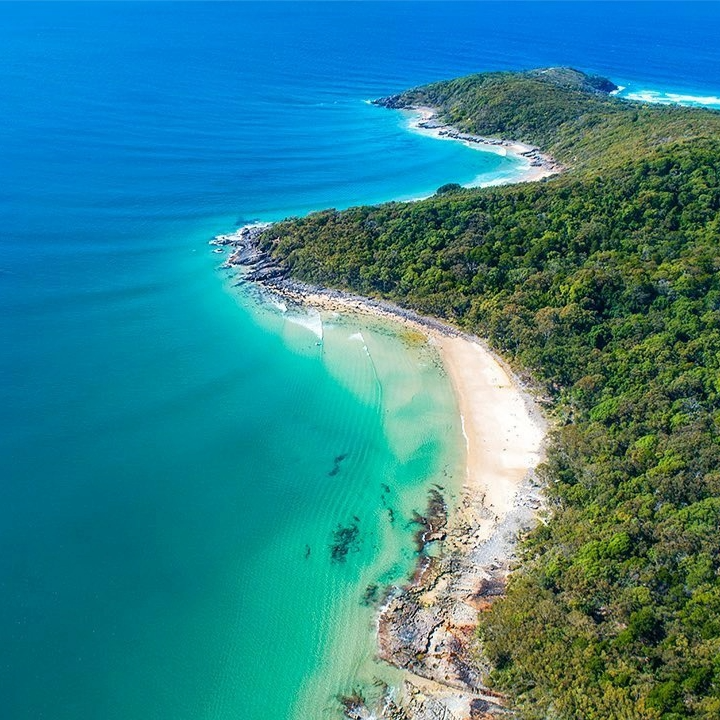
The headland at Noosa is one of the most accessible and beautiful coastal national parks in Australia. A network of walking tracks connects a series of beaches and coves — Tea Tree Bay, Granite Bay, Alexandria Bay — each with different character and surf exposure.
Alexandria Bay is clothing-optional by long-standing local convention and tends to attract a mellower crowd. Granite Bay has excellent snorkelling on the right tide. The coastal track between them, through coastal heath and past boulder outcrops with views over the Coral Sea, is one of the best short coastal walks in Queensland.
Best beach access: Tea Tree Bay and Granite Bay from the main car park; Alexandria Bay via the coastal track (30–40 minutes).
Cape Hillsborough National Park, Mackay
A small park north of Mackay with a beach walk that's become famous for one specific reason: kangaroos and wallabies come down to the beach at low tide each morning to feed on washed-up sea grass — often at sunrise, with the beach entirely to themselves (and you). It's one of those wildlife moments that feels implausible until you see it.
Best beach access: Cape Hillsborough Beach, accessed from the picnic area.
Whitsunday Islands National Park
Whitehaven Beach, on Whitsunday Island, sits inside the Whitsunday Islands National Park — accessible only by boat or seaplane from Airlie Beach. The 98% silica sand, the turquoise water, and the Hill Inlet lookout (where swirling sandbars create extraordinary patterns of white and blue) make it arguably the most beautiful beach in Australia.
Best beach access: Day trips and liveaboard tours from Airlie Beach. Camping permits available for overnight stays on the island.
Victoria
Wilsons Promontory National Park
"The Prom" is Victoria's most beloved national park and one of the great coastal parks in Australia. The southernmost point of mainland Australia, the Promontory encompasses over 50 kilometres of coastline including some of the finest beaches in the state.
Squeaky Beach (the quartz sand squeaks underfoot), Oberon Bay, Waterloo Bay, and Refuge Cove are all highlights — most requiring a walk of between one and five hours return from the Tidal River base. The park is heavily booked during school holidays and summer; camping permits are essential.
Best beach access: Squeaky Beach (45 minutes return); Oberon Bay (2.5 hours return); Refuge Cove (multi-day hike).
Port Campbell National Park, Great Ocean Road
Home to the Twelve Apostles, Loch Ard Gorge, and a series of dramatic clifftop formations. This is not a swimming park — the Southern Ocean here is powerful and the cliffs are vertical — but the coastal scenery is some of the most dramatic in Australia, and the protected cove at Loch Ard Gorge, where the famous 1878 shipwreck survivors came ashore, can be accessed via a steep walking track.
Best beach access: Loch Ard Gorge (swimming in the cove); Gibson Steps (beach walk below the Twelve Apostles).
Western Australia
Cape Range National Park / Ningaloo Marine Park
The combination of Cape Range National Park on land and Ningaloo Marine Park offshore creates one of Australia's most extraordinary natural experiences. The Ningaloo Reef runs parallel to the coast for over 300 kilometres — and in many places, the reef begins just metres from the beach.
Turquoise Bay is the standout: a crescent of white sand with reef directly offshore, accessible from a park car park with no facilities beyond a toilet block. The drift snorkel — where you enter the water at the southern end and let the current carry you over the reef — is one of the best snorkelling experiences in the world.
Best beach access: Turquoise Bay (drift snorkel), Oyster Stacks (strong snorkelling close to shore), Mandu Mandu Gorge (inland gorge walk).
D'Entrecasteaux National Park, Southwest WA
One of the most remote coastal parks in WA. The park stretches along a wild section of the southwest coast encompassing towering sand dunes, cliff-top heathland, and pristine beaches that see almost no visitors. Black Point, Salmon Beach, and the Yeagarup Dunes are highlights. A 4WD is required for most beach access.
Best beach access: Salmon Beach (4WD required), D'Entrecasteaux Beach (cliff-top walking access).
South Australia
Flinders Chase National Park, Kangaroo Island
Kangaroo Island's western tip is protected by Flinders Chase National Park — home to Remarkable Rocks (extraordinary granite formations sculpted by the Southern Ocean), Admirals Arch (a natural arch housing a New Zealand fur seal colony), and a string of wild, exposed beaches.
Harvey's Return and West Bay are the most accessible beach walks in the park. Neither is suitable for swimming — the southern ocean swell is powerful and the currents are strong — but the scenery is remarkable.
Best beach access: Remarkable Rocks coastal walk; Admirals Arch (sea lion and fur seal viewing); West Bay (coastal walk).
Tasmania
Freycinet National Park
One of the iconic national parks of Australia, Freycinet sits on the east coast of Tasmania — a granite peninsula of pink dolerite peaks, white sand beaches, and cold, clear water.
Wineglass Bay is the drawcard — a perfect arc of white sand accessed via a 45-minute walk over the saddle of Mount Amos. The views from the saddle are extraordinary and the beach below rarely crowded given the walk required to reach it. Hazards Beach, on the western side of the peninsula, is less visited and equally beautiful.
Best beach access: Wineglass Bay (45-minute walk from the car park); Hazards Beach (3-hour walk, or by boat).
Bay of Fires Conservation Area
Strictly speaking a conservation area rather than a national park, but worth including for the quality of the beaches. The northeast coastline of Tasmania — a series of white sand beaches backed by orange lichen-covered granite boulders — is one of the most photographed coastlines in Australia. The Bay of Fires Walk (a four-day guided walk offered exclusively by Bay of Fires Lodge) is one of Australia's premier wilderness experiences.
Best beach access: Binalong Bay (accessible by car, good swimming); Swimcart Beach (4WD or long walk).
What to Bring to a National Park Beach
National park beaches typically have minimal or no facilities. Beyond your usual beach kit, bring:
- More water than you think you need — at least two litres per person for any walk over an hour
- A map or downloaded offline trail map — mobile coverage is unreliable in most coastal parks
- Snacks that don't need refrigeration
- A compact rubbish bag — pack out everything
For the beach itself, a sand-free blanket that packs flat and a portable umbrella make the difference between a comfortable day and a logistically difficult one. The XO Beach Blanket rolls down small enough to fit in a daypack and sets up around an already-planted umbrella pole in seconds — no rearranging once you've found your spot.
Explore the full Xanto range at xanto.com.au.
Read more
From Bells Beach to Snapper Rocks, Margaret River to Noosa — a guide to Australia's best surf spots for every level, by state.
East coast beaches for golden-hour sunrises, west coast classics for sunsets — a guide to Australia's most spectacular beaches at the best time of day.